
The United States Navy Submarine Force has long held a reputation for precision and discipline. Submariners do not wander into danger. They calculate it. They accept it. And when things go wrong, they do not come halfway undone. They vanish. Cleanly. Completely. The sea closes over, and the world above is left with questions that are rarely answered in full.

April is one of those months where the ledger grows heavier. Across two wars and into the tense quiet of the Cold War, five submarines slipped beneath the surface and never returned. Their stories differ in detail, but they share a common ending. The kind the ocean writes without revision.
The first of these, the USS Pickerel, belonged to an earlier generation of submarines, a Porpoise class boat commissioned in 1937 when the United States was still trying to understand what undersea warfare might become. By the time war came, Pickerel had already proven herself capable. She conducted six war patrols in the early Pacific campaign, striking enemy shipping and operating in waters that were poorly charted and fiercely defended.
Her final patrol began on March 18, 1943. She departed Pearl Harbor with orders to hunt off the eastern coast of northern Honshu, Japan. On April 3, she made contact and attacked, sinking a Japanese submarine chaser. It was the sort of success that marked the aggressive spirit of the early submarine campaign. But success in those waters rarely went unanswered. Japanese aircraft and surface vessels responded with a punishing counterattack. Bombs and depth charges followed in quick succession.
Japanese reports describe oil rising to the surface, the usual sign of a kill. And yet there are indications that Pickerel may have survived the initial assault. Some evidence suggests she continued to operate for several more days, possibly sinking another vessel on April 7. What happened next is uncertain. She may have been finished by depth charges. She may have wandered into a minefield. The sea offers several possibilities and confirms none of them. What is known is that she did not return. Seventy-four men were lost with her, their patrol ending somewhere in the cold waters off Japan.
If Pickerel’s story is one of violent uncertainty, the USS Grenadier tells a different kind of tale, one that lingers longer in the memory because it did not end in immediate silence.
Grenadier, a Tambor class submarine commissioned in 1941, had already seen hard service. Among her successes was the sinking of Taiyo Maru, a transport whose loss carried consequences far beyond its tonnage. By April 1943, Grenadier was on her sixth war patrol, operating in the Strait of Malacca, one of the most dangerous stretches of water in the Pacific theater.
On the morning of April 21, she was caught on the surface by a Japanese aircraft. As she attempted to dive, bombs fell. The explosions knocked out her power and lighting. The submarine settled to the bottom at roughly 270 feet, crippled and unable to maneuver.
What followed was not a sudden end, but a long fight for survival. For thirteen hours, the crew battled heat, smoke, and failing systems. The air grew foul. Temperatures climbed. The boat held together, barely. Against the odds, they managed to bring her back to the surface.
But survival did not mean escape. Her propulsion system was ruined. She could not run. At dawn on April 22, enemy ships approached. The crew fought off another air attack with machine gun fire, a desperate, almost defiant act. Then came the inevitable order. The boat would be scuttled.
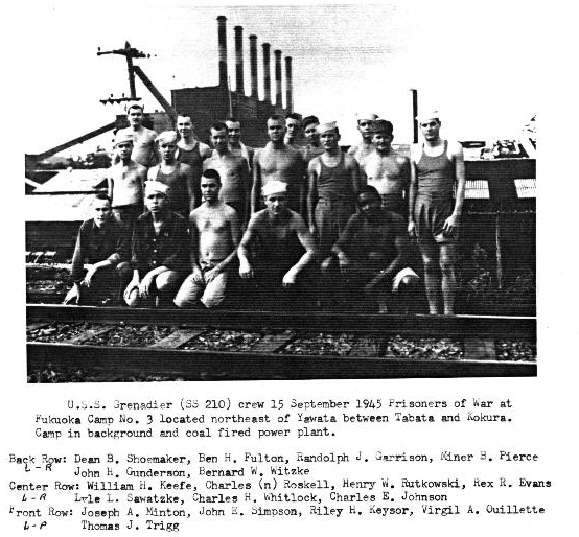
All seventy-six men abandoned ship. They survived the sinking, only to be taken prisoner. Their war was not over. It simply changed form. They endured two years of brutal captivity. Seventy-two would live to see the end of the war. Four would not. Grenadier’s loss was not a silent vanishing, but it carried its own heavy cost, stretched across years instead of moments.
The USS Gudgeon represents yet another chapter in this April ledger, one that blends achievement with disappearance.
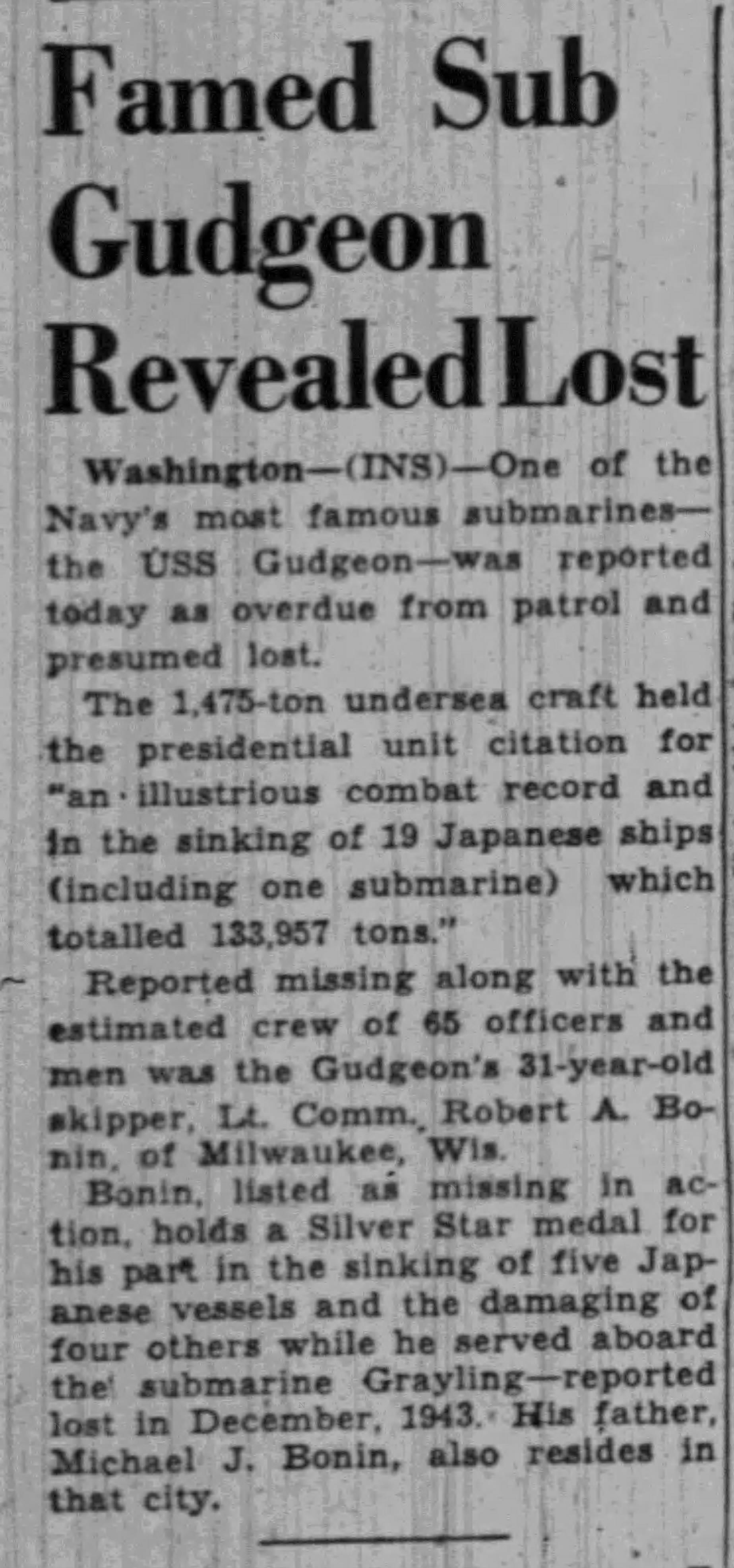
Commissioned in 1941, Gudgeon holds a distinct place in submarine history. In January 1942, she sank the Japanese submarine I-73, becoming the first U.S. submarine to destroy an enemy warship in World War II. It was a moment that signaled what American submarines could become in the Pacific war. Over the course of her career, she built a formidable record, sinking fourteen confirmed ships and earning the Presidential Unit Citation.
Her twelfth war patrol began in April 1944. She departed Pearl Harbor and refueled at Johnston Island on April 7. After that, she was never heard from again. There was no distress call, no fragment of a message to mark her end.
Postwar analysis of Japanese records offers a likely explanation. Patrol aircraft reported attacking a submarine in mid-April, dropping bombs that triggered a massive underwater explosion. It is believed this was Gudgeon. Another theory points to heavy depth charge attacks weeks later. Both scenarios share a common element. Sudden destruction. No survivors.
Around eighty men were lost. A boat that had helped define the early war simply vanished into it, her final moments known only through the fragments left behind by those who hunted her.
Then there is the USS Snook, a Gato class submarine commissioned in 1942, a veteran of the most intense phase of the Pacific submarine campaign. Snook was an effective and aggressive hunter, credited with sinking between seventeen and twenty-two enemy vessels depending on how one counts the records.
Her story, however, carries a grim and complicated footnote. During one of her patrols, she sank the Arisan Maru, a Japanese transport. Unknown to her crew, the ship carried nearly 1,800 American prisoners of war. It stands as one of the most tragic incidents of the war at sea, a reminder that even success in war can come wrapped in unintended consequences.
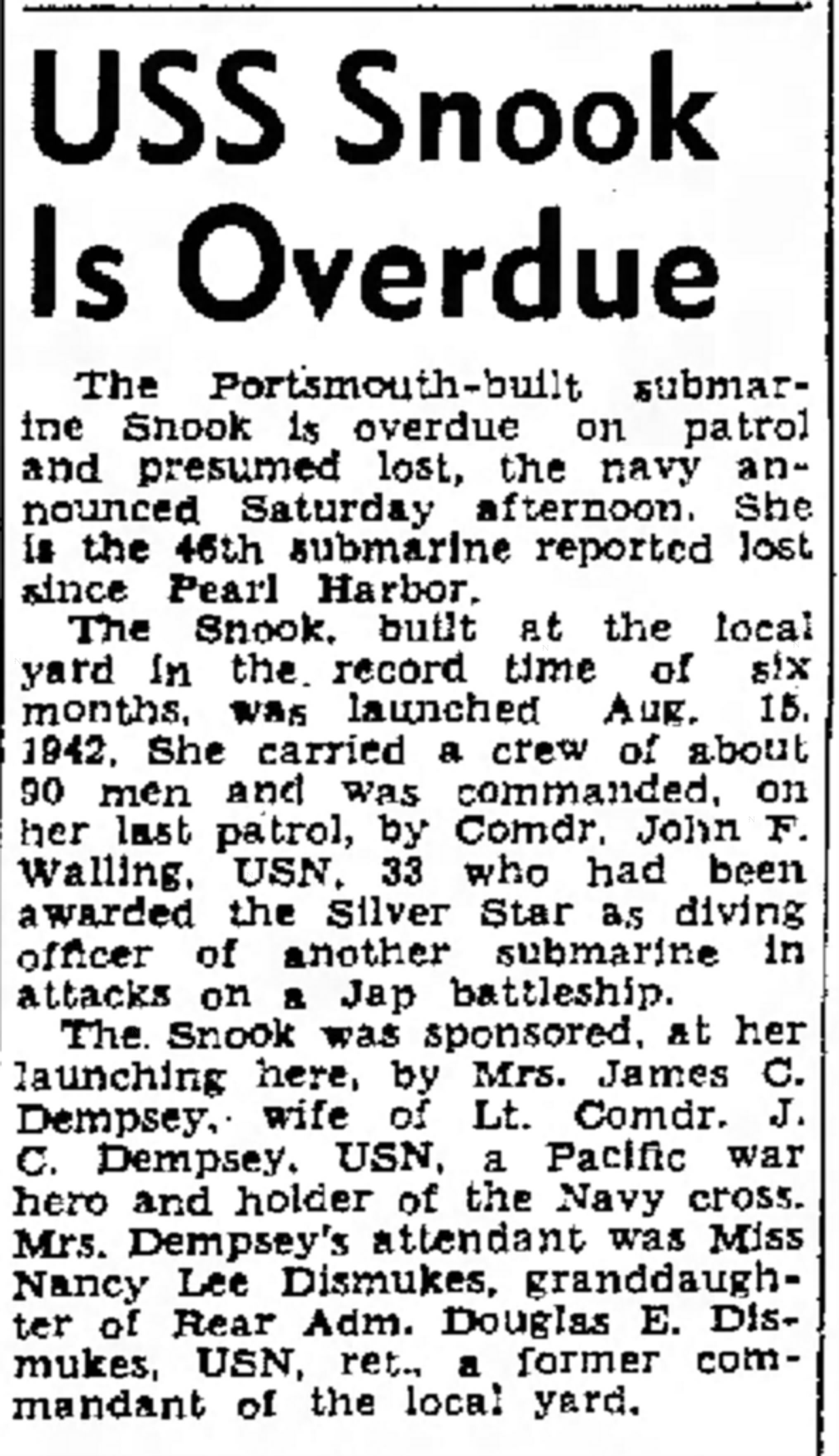
Snook departed Guam on March 25, 1945, beginning her ninth war patrol in the South China Sea and Luzon Strait. She operated as part of a coordinated attack group, an indication of how far submarine tactics had evolved since the early days of the war.
Her last communication came on April 8. After that, silence. Orders went unanswered. Opportunities to assist downed aviators passed without acknowledgment. She was simply gone.
Theories about her loss vary. She may have been attacked by a Japanese submarine. She may have struck a mine. She may have been overwhelmed by combined air and surface forces. The war was reaching its final, violent crescendo in those waters, and danger came from every direction. What remains certain is that eighty-four officers and men did not return. Snook’s final patrol ended somewhere in contested seas that kept their secrets.
The final entry in April’s ledger brings us forward into a different era, one that believed it had mastered the lessons of the past.
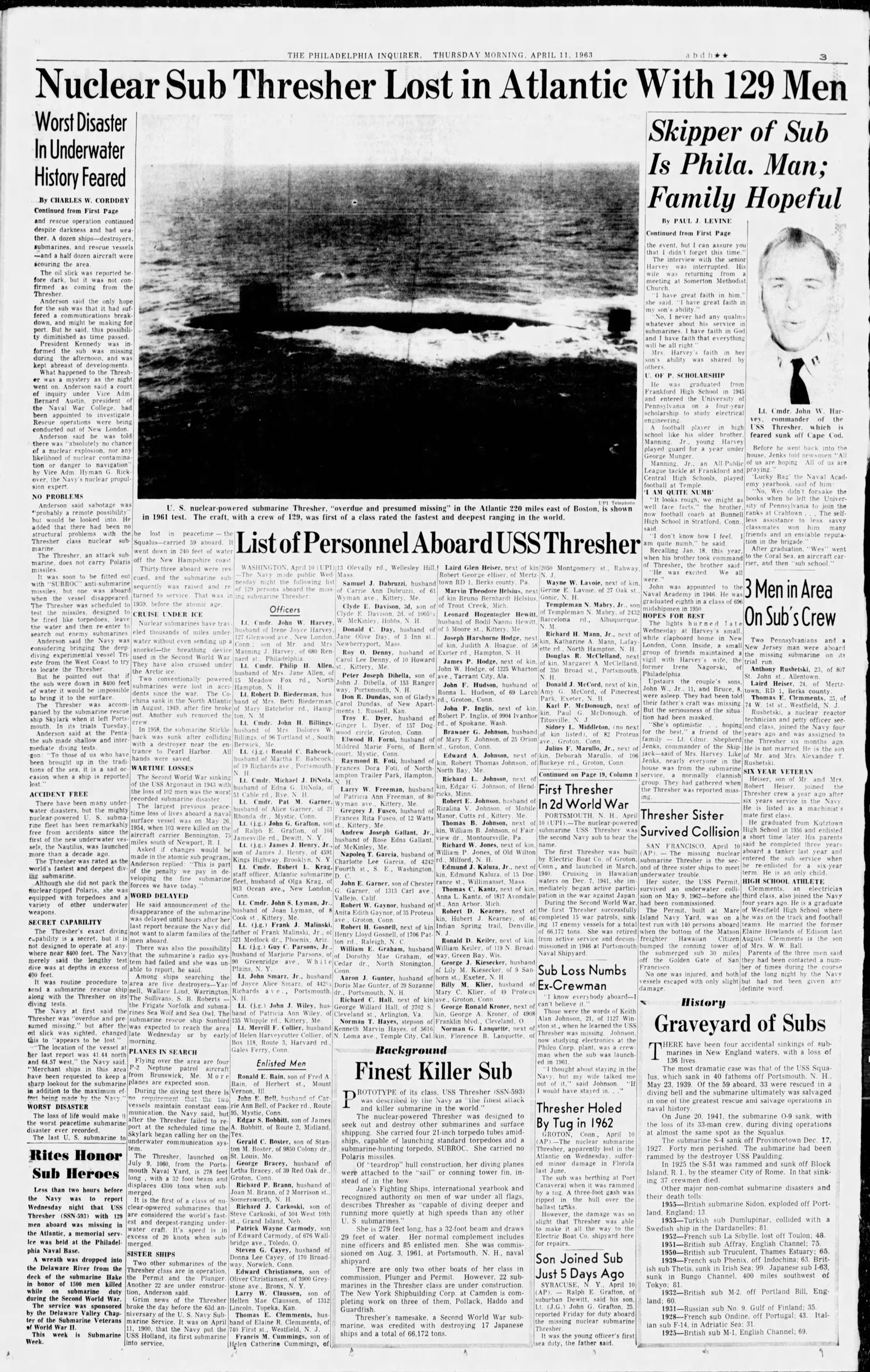
USS Thresher was not a World War II boat. She was the future. Commissioned in 1961, she was the lead ship of a new class of nuclear-powered attack submarines, designed to be faster, quieter, and more capable than anything that had come before. She represented the cutting edge of naval engineering, built to operate in the deep, cold environment of the Cold War.
On April 10, 1963, Thresher was conducting deep-diving tests roughly 220 miles east of Cape Cod. She was accompanied by the rescue ship Skylark, maintaining contact as she descended.
At first, the reports were routine. Then came a message, partially garbled, indicating minor difficulties. Another transmission followed. The crew was attempting to blow ballast.
Those words carry a particular meaning in the submarine community. They mean the boat is trying to surface, urgently.
Then contact was lost.
What followed was pieced together from evidence, analysis, and hard engineering reality. A silver-brazed piping joint likely failed, allowing high-pressure seawater to flood into the engine room. The influx of water caused the nuclear reactor to shut down automatically, eliminating propulsion. Without power, the submarine could not arrest her descent.
The crew attempted an emergency blow of the ballast tanks, forcing high-pressure air into them to drive the water out and bring the submarine to the surface. But moisture in the air system froze as it expanded rapidly, forming ice that clogged the valves. The system failed at the moment it was needed most.
Without propulsion and without effective buoyancy control, Thresher sank below her crush depth. Sonar operators detected the unmistakable sound of implosion. One hundred twenty-nine men, sailors and civilian technicians, were lost.
Thresher’s loss was not just a tragedy. It was a turning point. The United States Navy responded with the SUBSAFE program, a comprehensive overhaul of submarine design, construction, and maintenance standards. Every system critical to a submarine’s ability to surface and survive was scrutinized, redesigned, and strictly controlled.
Since SUBSAFE was implemented, no SUBSAFE-certified submarine has been lost. That record is not the result of luck. It is the product of discipline forged in the aftermath of catastrophe.
Five boats. Pickerel, Grenadier, Gudgeon, Snook, Thresher. Different designs, different wars, different circumstances. Combat, capture, disappearance, and engineering failure. Yet they are bound together by a single truth that submariners understand better than most.
The sea does not forgive mistakes, and it does not return what it takes.
Somewhere beneath vast, dark waters, these submarines remain. Not as relics, but as markers. Of risk accepted. Of duty carried out to its final measure.
They are not forgotten. They are remembered in the quiet rituals of the submarine service, in the tolling of bells, in the reading of names, and in the discipline that keeps today’s boats safe.
They are on eternal patrol.
And April, whether the ocean notices or not, will always belong to them.




 The Puget Soundings
Leave a comment