
TITLE: THE FINAL SANCTUARY: THE LOSS OF USS BONEFISH
SCENE 1: THE SILENT ARTERY (0:00-1:00)
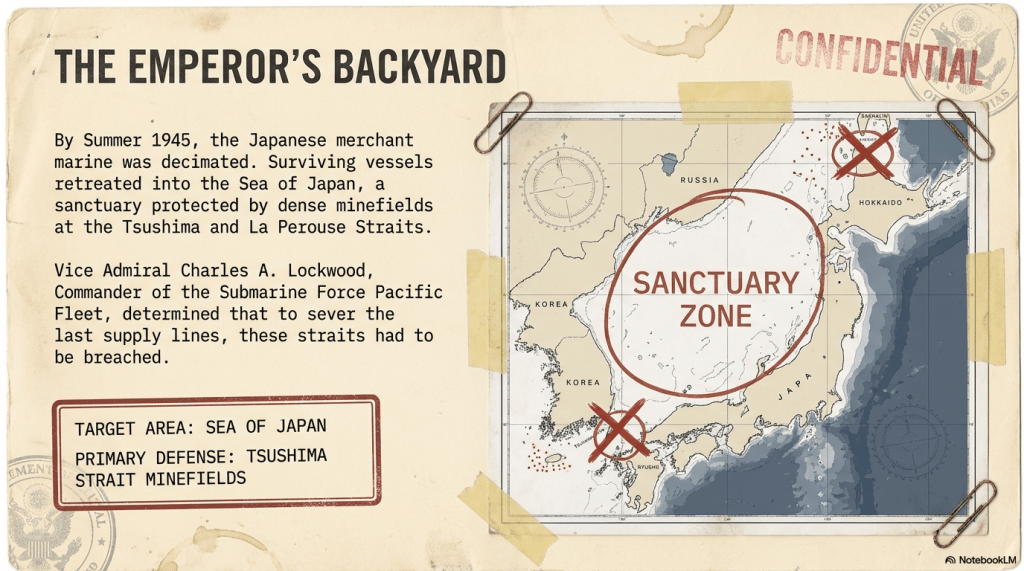
NARRATOR: By the summer of 1945, the Japanese merchant marine had been decimated, and surviving vessels were forced into the Sea of Japan, a body of water protected by dense minefields at the Tsushima and La Perouse Straits. Vice Admiral Charles A. Lockwood, Commander of the Submarine Force Pacific Fleet, was determined to penetrate this “sanctuary” to sever the last of the Japanese overseas supply lines.
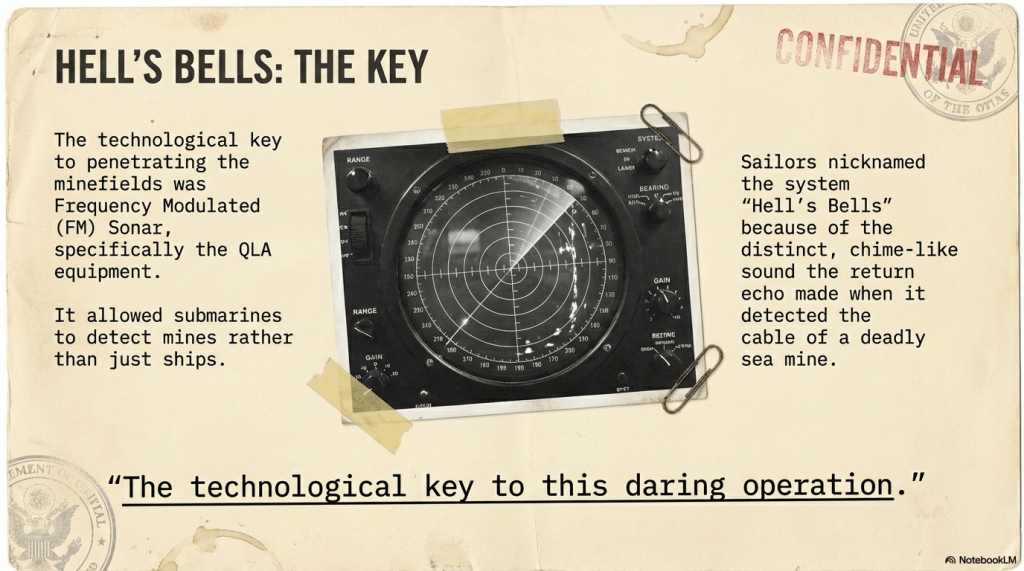
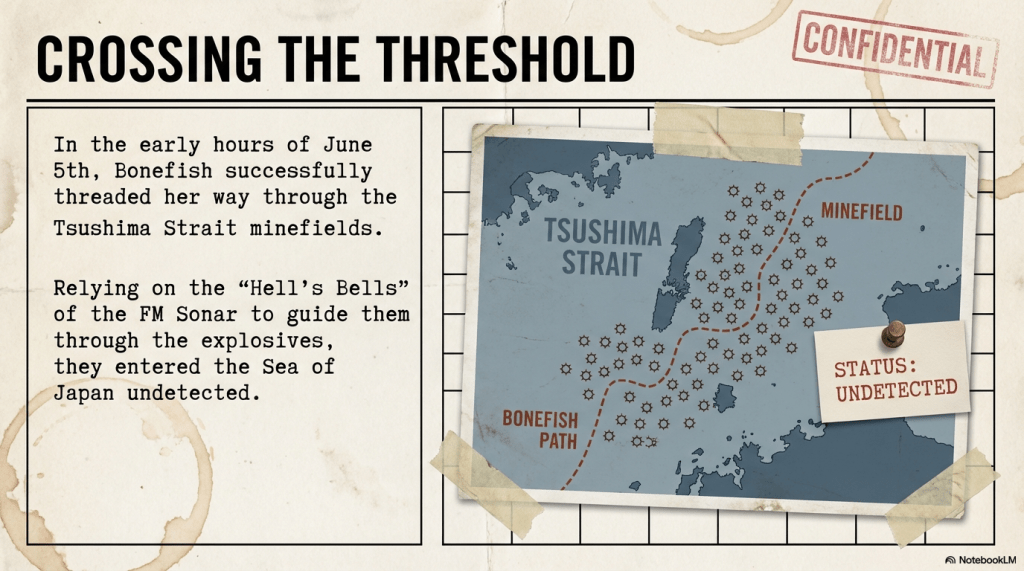
The technological key to this daring operation was Frequency Modulated (FM) Sonar, specifically the QLA equipment. The sailors nicknamed it “Hell’s Bells” for the chime-like sound the return echo made when it detected the cable of a deadly sea mine.
VISUAL: Black and white archival footage of Admiral Lockwood at his desk, followed by a diagram of the Tsushima Strait and a shot of the QLA sonar screen.
SCENE 2: THE SHIP AND THE CREW (1:00-1:45)
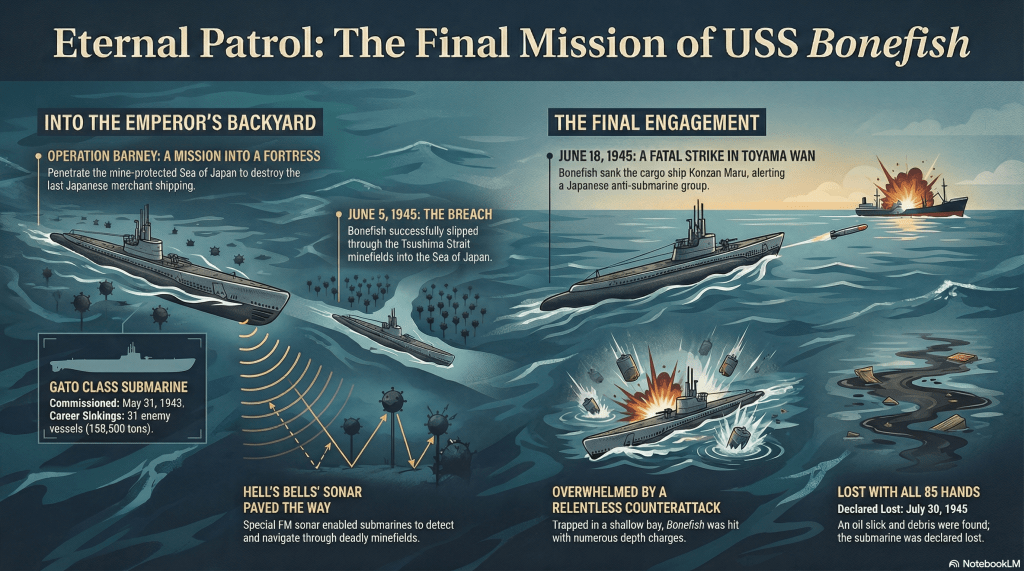
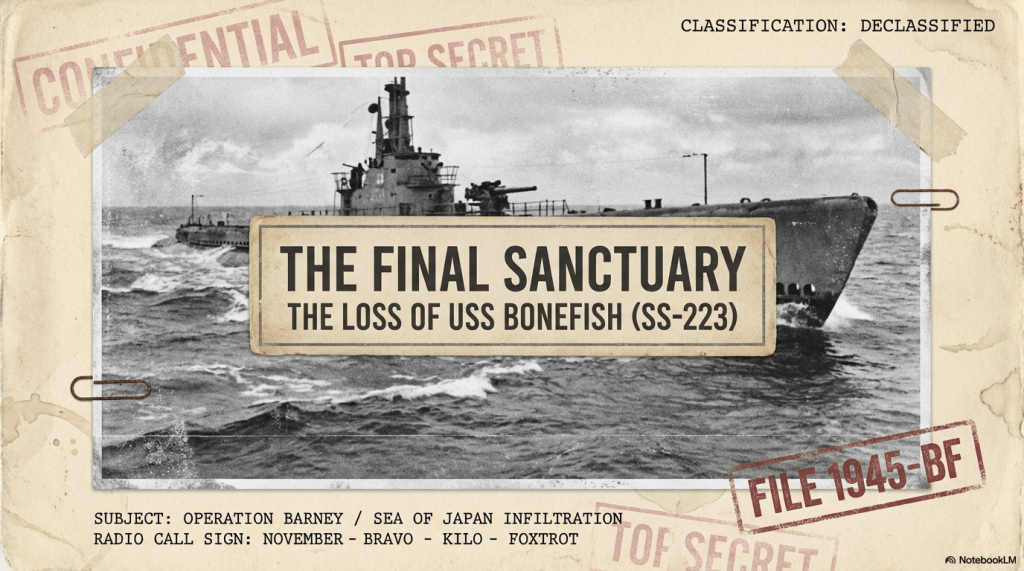
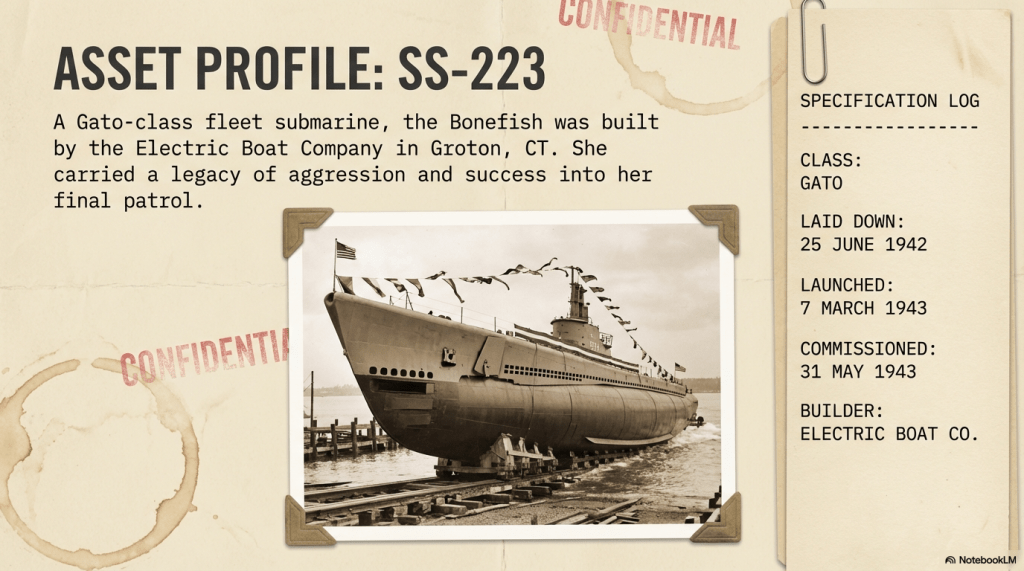
NARRATOR: Among the nine submarines selected for this mission, dubbed Operation Barney, was the USS Bonefish (SS-223). A Gato-class fleet submarine built by the Electric Boat Company, the Bonefish was launched in March 1943 and carried an impressive record into her final patrol.
Under her first commander, Thomas Wesley Hogan, she sank over 24,000 tons on her first patrol alone. By June 1944, command passed to Commander Lawrence Lott Edge, a 1935 Naval Academy graduate known for his aggressive tactical approach. By the end of her career, Bonefish would be credited with sinking 31 enemy vessels totaling 158,500 tons.
VISUAL: Photos of the Bonefish launching in Groton and portraits of Commanders Hogan and Edge.
SCENE 3: INTO THE EMPEROR’S BACKYARD (1:45-2:45)
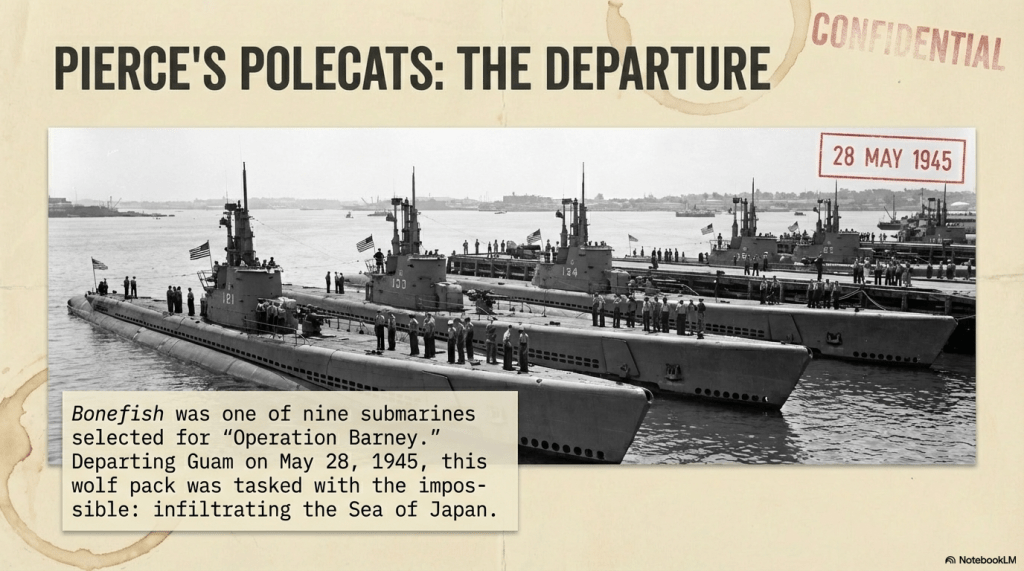
NARRATOR: On May 28, 1945, Bonefish departed Guam as part of a coordinated attack group named “Pierce’s Polecats”. In the early hours of June 5th, she successfully threaded her way through the minefields of the Tsushima Strait, entering the Sea of Japan undetected.
For nearly two weeks, the “Hellcats” pack ran amok, discovering a tactical environment where merchant ships often sailed with running lights burning, believing the waters were impenetrable to the Americans. On June 16, Bonefish rendezvoused with the USS Tunny, reporting she had already sunk a large transport and a medium freighter.
VISUAL: Animated map showing the nine submarines splitting into the Sea of Japan, interspersed with footage of periscope views of Japanese merchant ships.
SCENE 4: TOYAMA WAN (2:45-4:00)
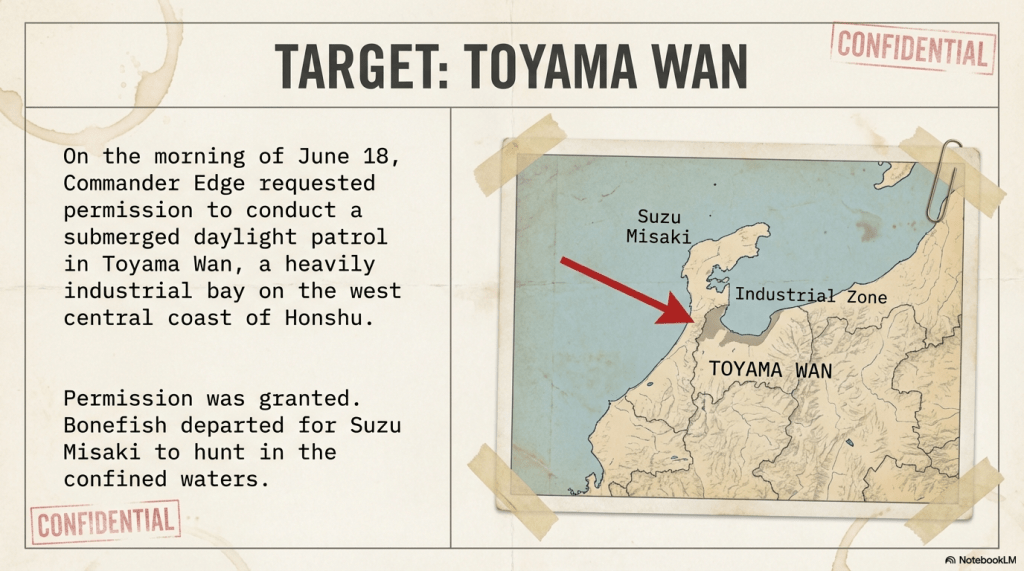
NARRATOR: On the morning of June 18, Commander Edge requested permission to conduct a submerged daylight patrol in Toyama Wan, a heavily industrial bay on the west central coast of Honshu. Permission was granted, and Bonefish departed for Suzu Misaki.
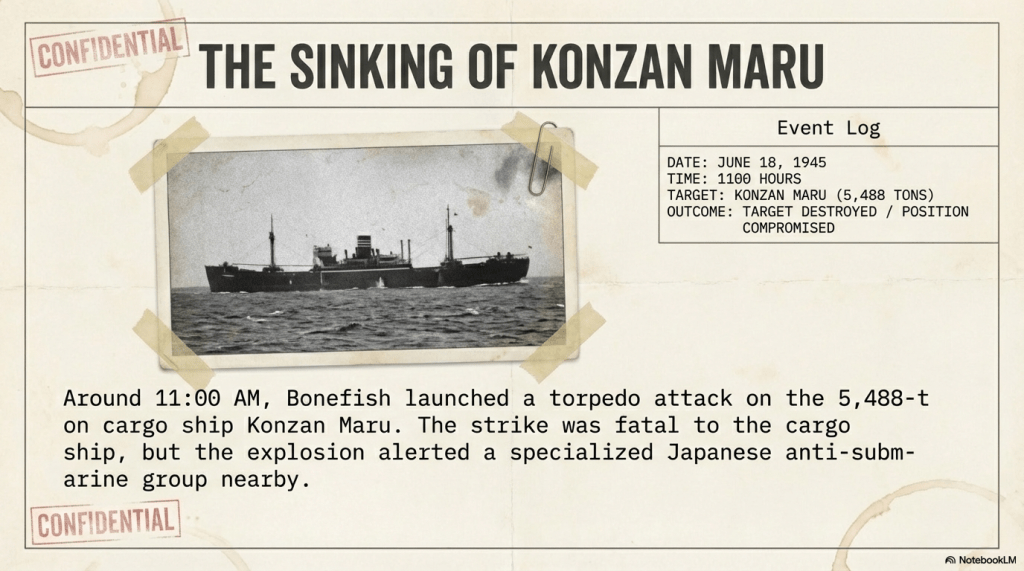
Around 11:00 AM, Bonefish launched a successful torpedo attack on the 5,488-ton cargo ship Konzan Maru. The strike was fatal, but it alerted a specialized Japanese anti-submarine group led by the kaibōkan Okinawa.
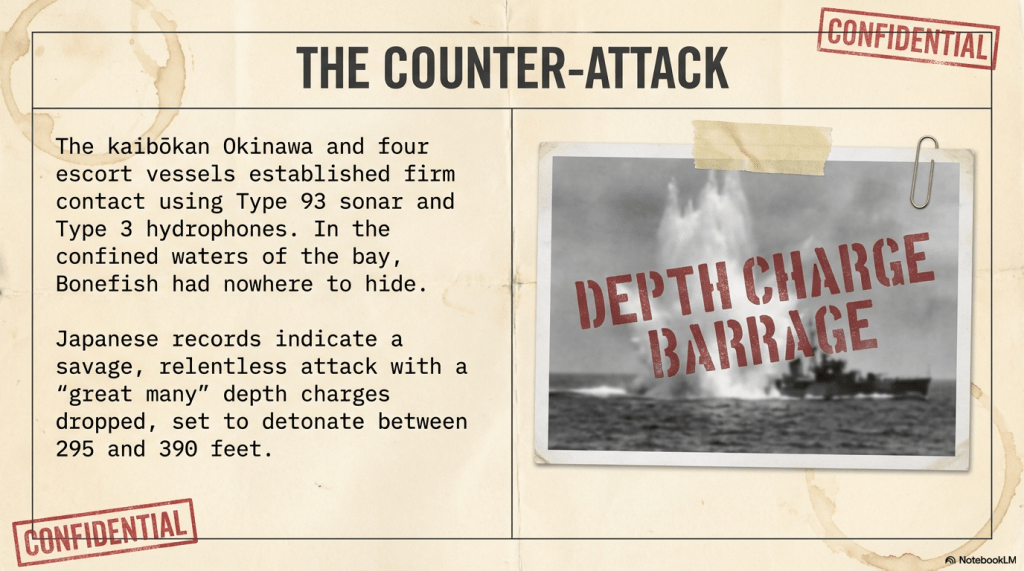
Equipped with Type 93 sonar and Type 3 hydrophones, the Okinawa and four escort vessels established firm contact with the submerged submarine. Japanese records indicate a savage and relentless counterattack. A “great many” depth charges were dropped, set to detonate between 295 and 390 feet. In the confined waters of the bay, the Bonefish had nowhere to hide.
VISUAL: Re-enactment of sonar pings increasing in speed; archival footage of depth charges exploding in the water.
SCENE 5: ETERNAL PATROL (4:00-5:00)
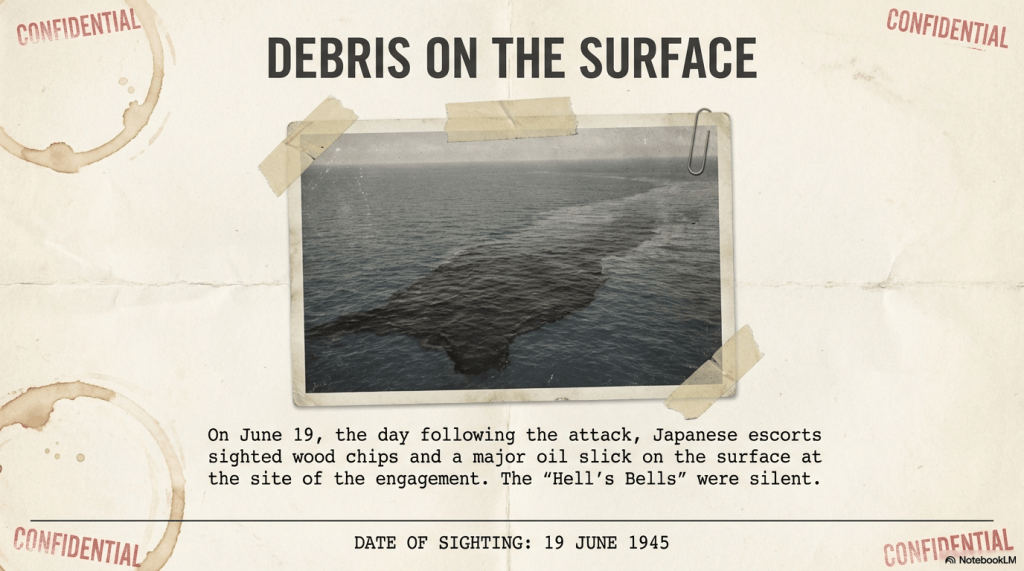
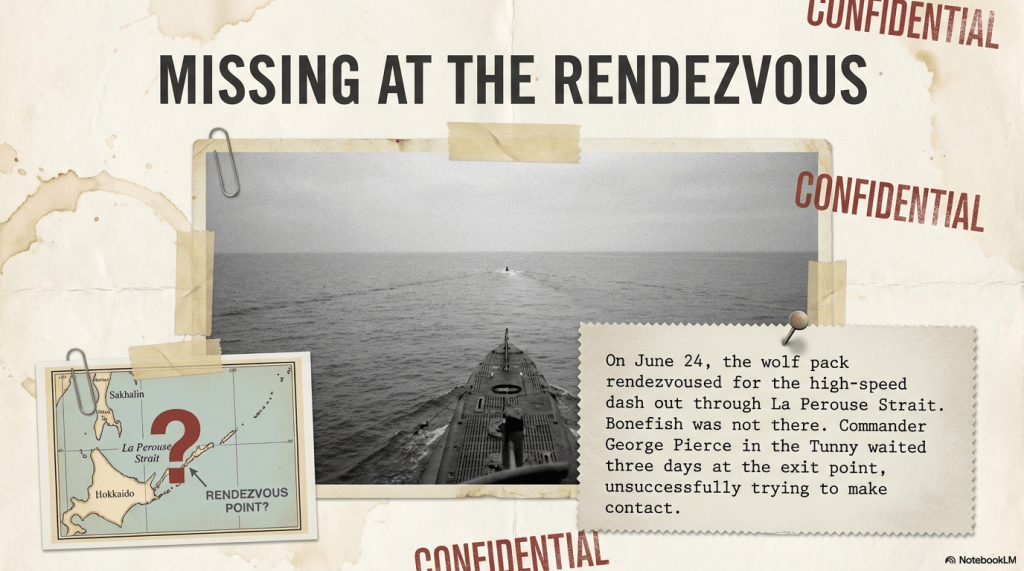
NARRATOR: The following day, June 19, Japanese escorts sighted wood chips and a major oil slick on the surface at the site of the attack. On June 24, when the pack rendezvoused for their high-speed dash out through La Perouse Strait, the Bonefish was missing.
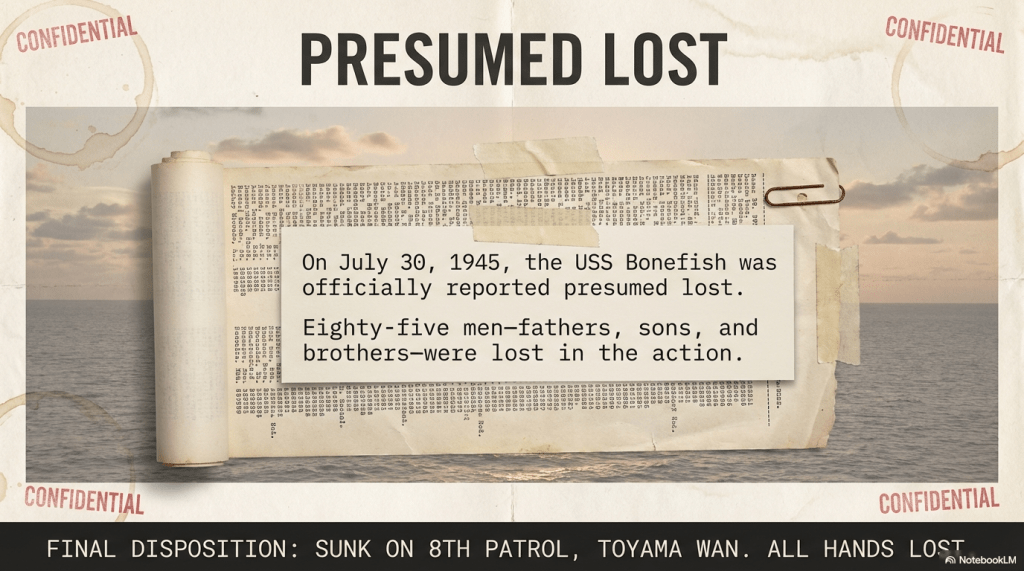
Commander George Pierce in the Tunny waited three days at the exit point, unsuccessfully trying to make contact. On July 30, 1945, the USS Bonefish was officially reported presumed lost.
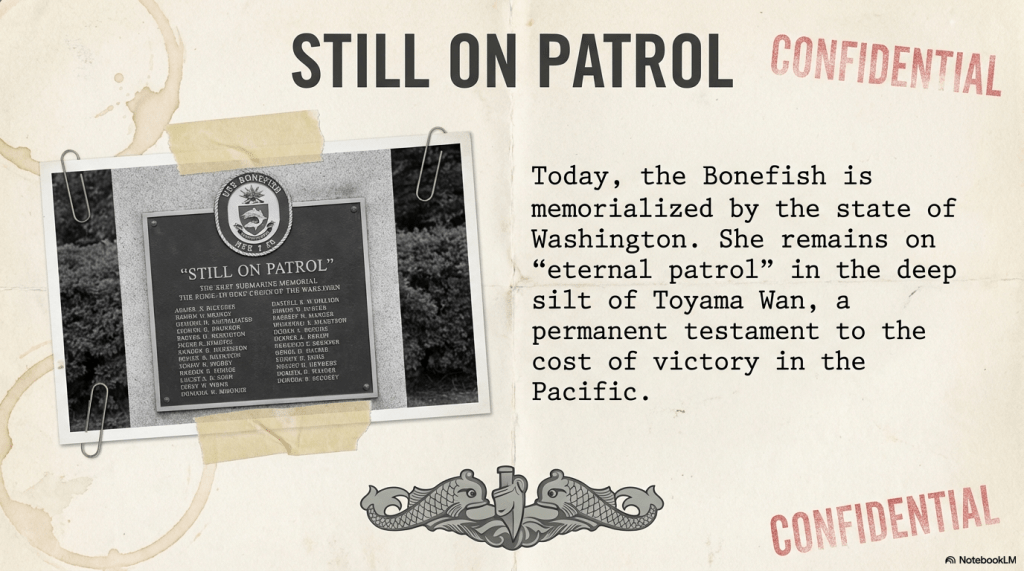
Eighty-five men—fathers, sons, and brothers—were lost in the action. Today, the Bonefish is memorialized by the state of Washington and remains on “eternal patrol” in the deep silt of Toyama Wan, a permanent testament to the cost of victory in the Pacific.
VISUAL: The “Still on Patrol” plaque at the Submarine Memorial, followed by the names of the 85 lost crew members scrolling over a shot of the sunset on the Pacific.
[FADE TO BLACK]





 The Puget Soundings